
Padua
Find accommodation
For a first visit to Padua, the best combination is a clear focus on art and a second, more open-ended part of the city. Giotto’s frescoes in the Scrovegni Chapel are a subject in their own right; the Palazzo della Ragione and the city squares offer a different view of Padova, as the city is called in Italian. Prato della Valle adds yet another accent, with water, statues and a central green island. If you have only one day, there is no need to turn it into a complete tour of every famous landmark. If you are staying for several days, you can take your time connecting the city’s different parts.
 Padua
Photo: Emanuel Winklhofer auf Pixabay
Make Giotto the focus, not a quick box to tick
The Scrovegni Chapel contains a continuous cycle of frescoes, created by Giotto between 1303 and 1305. The scenes tell stories from the lives of Joachim and Anne, as well as Mary and Jesus. The Last Judgment is on the interior wall of the façade, while the vault bears a blue, starry sky. The images are therefore not individual paintings on unrelated walls, but part of a narrative conceived for the space. It is worth making this connection the focus of your visit.
Advance reservations are required for the Scrovegni Chapel. If Giotto is your particular interest, treat your booked chapel visit as the fixed art highlight of the day, then add a shorter walk around the city. A visit cannot be replaced by a quick look at the exterior façade. Nor does it have to be followed immediately by another major art attraction. After an immersive visit to the frescoes, a different kind of urban space can help keep the trip varied: historic squares instead of more cycles of images, or the open expanse of Prato della Valle later on.
Urbs Picta is more than the Scrovegni Chapel
Padua’s fourteenth-century fresco cycles form a UNESCO World Heritage listing in their own right. The serial property comprises eight buildings and monumental complexes in four distinct areas. The Scrovegni and Eremitani area is only one of them. Other areas bring together the Palazzo della Ragione, the Reggia, the Baptistery and their squares, the area around the Basilica of Saint Anthony, and San Michele. This helps explain why an in-depth art visit involves more than a single interior.
Alongside Giotto, names such as Guariento, Giusto de’ Menabuoi and Altichiero da Zevio represent this development in mural painting. If you are planning several days in Padua, you can make a focused comparison of religious and secular spaces, different patrons and varied visual programmes. For a single day in the city, however, choosing one main focus usually makes more sense. The themed guide to UNESCO sites in Veneto helps distinguish Padua’s fresco ensemble from other cultural destinations in the region; the entire city is not a World Heritage Site.
Palazzo della Ragione: the city’s history beneath a vast roof
The Palazzo della Ragione was the seat of the city courts. Its great hall and roof, which from inside resembles an inverted ship’s hull, make it a very different experience from the Scrovegni Chapel. Here, architectural history, public function and imagery come together. The fresco decoration seen today should not simply be described as Giotto’s surviving work: a fire destroyed the earlier paintings in 1420, and the renewed astrological cycle was created afterwards.
If you are interested in how a medieval city was organised and presented itself, the Palazzo can be your main destination. Its depictions of law and justice, together with its astrological images, give the hall a distinctive coherence. It is not just another interchangeable fresco room. Its location beside the central squares also suits the theme: the palace belongs to civic Padua and leads the mind back out of its decorated interior and into the city.
Prato della Valle for a different kind of urban space
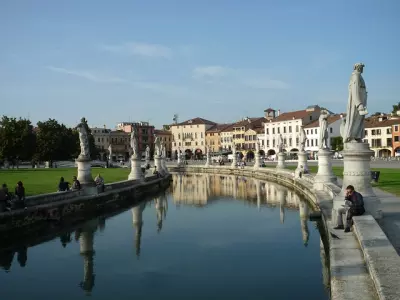
At Prato della Valle, the scale changes. The central Isola Memmia features trees and lawns; a canal surrounds the island, its banks lined with statues of historical figures. The square took shape through an urban redesign initiated by Andrea Memmo in the eighteenth century. With its combination of greenery, water and stone figures, it contrasts sharply with the narrow streets of the historic centre.
This area is a good counterpoint to a concentrated art visit. The island and the surrounding canal create a distinct spatial order that you can appreciate without embarking on another series of indoor visits. Prato della Valle should not be confused with the square in front of the Basilica of Saint Anthony. The basilica is a separate religious landmark in the southern part of the city. If you focus on this part of Padua, treat it as a visit in its own right, rather than merely the last stop on a long fresco tour.
Keep the Botanical Garden and everyday city life distinct
The Botanical Garden of Padua is another UNESCO World Heritage Site in its own right, separate from the fresco cycles. The garden and mural painting are therefore two different cultural themes. If you have a particular interest in plants and garden culture, you can make the garden the main destination for a day. But a short visit does not have to cover both World Heritage themes in full to be worthwhile. The squares, streets and the tradition of Caffè Pedrocchi also offer distinctive ways to experience the city.
For a wider choice of places to stay in the surrounding area, the accommodation section for the Province of Padua offers a broader geographic range. For a trip consisting mainly of city visits, proximity to the city is the key consideration. A spa town serves a different purpose: Abano Terme or Montegrotto Terme are a good fit if relaxation is the main focus of your stay and you want to add a selected cultural day in Padua. They are not simply alternative places to stay for a trip based entirely in the city.
One day, several days, or a trip from the hills?
With just one day, either “Scrovegni Chapel and an urban setting” or “Palazzo della Ragione and its surrounding squares” makes a good plan. Over several days, you can add another focus in the southern part of the city or at the Botanical Garden. The Euganean Hills complement Padua with countryside and smaller towns, but they are no substitute for a second day in the city if you want to explore its frescoes in greater depth. The key is the order of your interests: decide whether art, the city or relaxation is your main priority, then choose the right second element.
