
Discover Venice: walks between Rialto, art, and canals
Find accommodation
Venice reveals itself through three distinct cityscapes: the monumental squares around San Marco, the canals and residential neighborhoods north of the Grand Canal, and the art venues and waterfront walks of Dorsoduro. For a first visit, a continuous walk through one of these areas is more rewarding than constantly moving back and forth between individual sights. St Mark’s Square and Rialto make a good starting point; Cannaregio, Castello, and the southern waterfront add other perspectives.
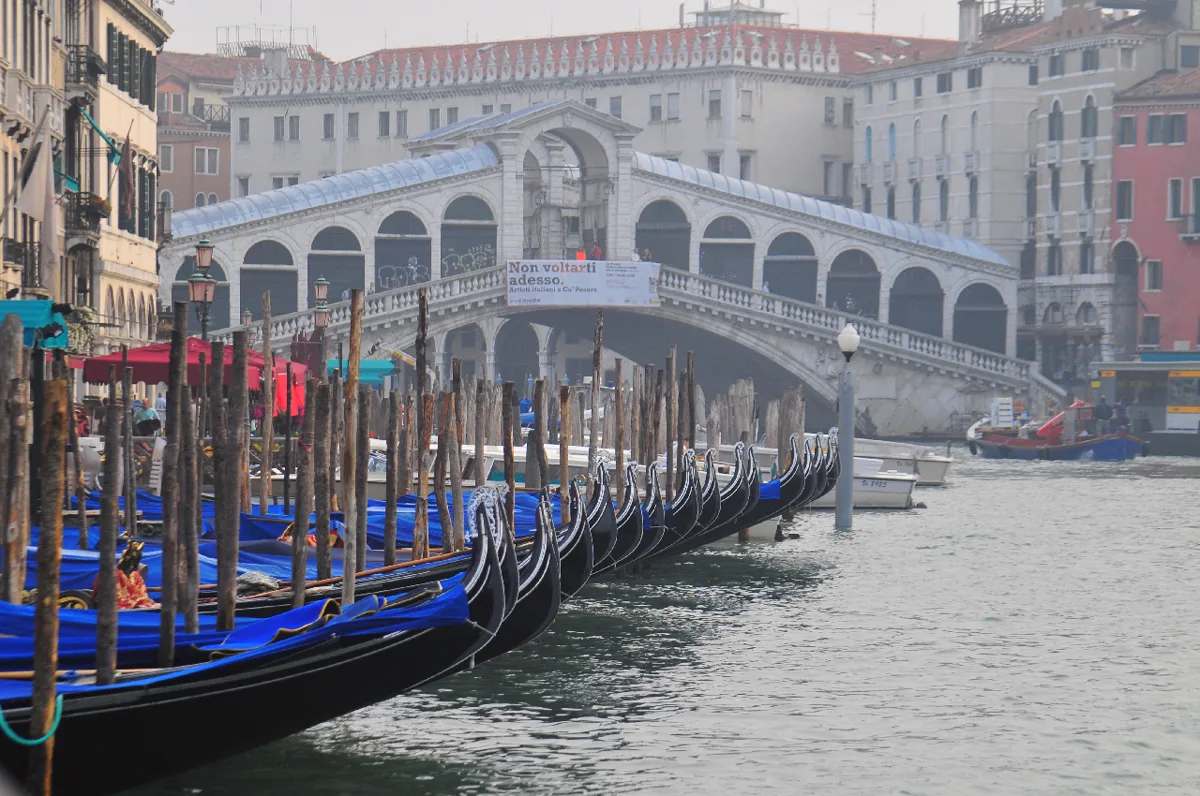 Gondeln am Canal Grande mit der Rialtobrücke im Hintergrund.
Photo: Alesia Belaya
The historic city lies on islands in the lagoon. Canals and bridges both connect and divide its routes. Venice and its lagoon are a UNESCO World Heritage Site, but the city is also a place to live and work, as well as a transport hub on the water. This mix is what makes a walk so interesting: between palazzo facades, small squares, and boat stops, your perspective and sense of scale keep changing.
Understanding the city map: the Grand Canal and six sestieri
The Grand Canal is the main landmark running through the historic city. Its two banks do not form a continuous walking route; many lanes lead to the water and end there. A destination on the opposite bank may therefore mean taking a detour to the next bridge. For a walk, it makes sense to stay on one side at first and deliberately build a crossing into your route.
The six historic districts are called San Marco, San Polo, Santa Croce, Cannaregio, Castello, and Dorsoduro. San Marco is the monumental center, while San Polo is known for Rialto and major art venues west of the Grand Canal. Santa Croce lies on the arrival side, near Piazzale Roma, while Cannaregio is on the station side. Castello stretches east, and Dorsoduro opens south toward art collections and waterfront walks. Comparing the districts as places to stay is especially useful when choosing accommodation.
First walk: Rialto and monumental San Marco
Rialto and St Mark’s Square can be seen as one shared focal point of the city. From the Rialto Bridge, the Grand Canal comes into close view: palaces, boats, and movement between the banks shape the scene. The market area is on the San Polo side, while lanes on the San Marco side lead farther into the monumental center. When you arrive here, don’t hurry straight off to the next photo spot. First, take in the contrast between the waterway and the pedestrian lanes.
St Mark’s Basilica and the Doge’s Palace stand on St Mark’s Square as two closely linked facets of the city’s history: religion and the political power of the former Republic. Even viewing them from the outside makes for a worthwhile visit. Going inside takes extra time and should not be treated as a quick stop between Rialto and a boat to the islands. For a first day, it is better to focus on this area than to schedule several major visits back to back.
The passage from the square to the water opens up views across the Basin of San Marco. From there, you can continue your walk toward Castello or finish with a break. The route between Rialto and San Marco is only one slice of Venice, not the whole experience of the city. Small detours off the main route show how closely homes, shops, churches, and passageways sit alongside one another. Keep doorways and narrow bridges clear as you go.
Second walk: Cannaregio and the northern canals
Cannaregio is a good contrast to the monumental center. Santa Lucia station is on its western side, and from there routes through the district continue toward Rialto. Away from this main connection, longer stretches of canal alternate with small squares and residential streets. The historic Jewish Ghetto gives the walk its own focus on history, rather than serving merely as a quieter detour around the best-known sights.
For this walk, it’s worth following one stretch of canal and then continuing to a nearby square. A route that treats every lane as a shortcut can easily lose its sense of direction. Cannaregio is not uniformly quiet, either: the area around the station and the through-routes have a different rhythm from the side waterfronts. If you want to get to know the neighborhood, set aside a dedicated part of your visit for it rather than just the last few minutes before your train leaves.
At the northern edge of the city, the lagoon becomes a stronger part of the view. Fondamente Nove is an important point of reference for routes to the islands. The view over the water here is different from the palace facades along the Grand Canal: the city opens onto a landscape of islands and water. For onward travel to Murano, the walk to the boat stop is a leg of its own; glass art and a city walk do not have to fit into the same short morning outing.
Third walk: art and southern waterfronts in Dorsoduro
Dorsoduro is ideal for a day combining art and city views. The Gallerie dell’Accademia, the Peggy Guggenheim Collection, and Santa Maria della Salute each offer a different perspective. It’s more enjoyable to pair one of these art venues with a waterfront walk than to include all three as mere names on a long itinerary. That leaves time to really take in the surroundings between visits.
The Zattere runs along the district’s southern waterfront. From here, the view looks across the Giudecca Canal rather than into a narrow lane. Giudecca lies opposite and belongs to the sestiere of Dorsoduro, but there is no footbridge connecting it to the district. You need to travel by water to visit. If you focus your day on Dorsoduro, you can first enjoy the island opposite as part of the panorama and plan a separate visit for later.
San Polo can also be explored with an art focus: the Frari Church and the Scuola Grande di San Rocco give a route west of the Grand Canal a different character from Rialto alone. This is an alternative to Dorsoduro, not an automatic extension of it. On a longer stay, two art days in geographically compact areas are often more enjoyable than a day involving several crossings and long return journeys.
Castello: extend your walk east
Castello changes between its western, central area and the neighborhoods farther east. The Arsenale and the Giardini are prominent landmarks. A cultural visit follows different routes around them than one focused mainly on the stretch between St Mark’s Square and Rialto. If you’re planning a major exhibition visit, allow enough time for the eastern part of the city rather than heading there only after a full day of sightseeing.
For a walk without a set exhibition itinerary, Castello offers a different sense of space: your view shifts from the busy center to longer waterfront stretches, squares, and neighborhoods. The Venice Biennale is a cultural draw in its own right. But Castello can also be experienced as a neighborhood outside the context of such an event, without making every walk revolve around a venue.
What fits into one day, and what takes several?
For a day trip, combining Rialto, San Marco, and a walk in a neighboring area makes a compelling introduction. A major visit indoors leaves less time for exploring other districts. Two full days in the city let you separate the monumental center from an art-focused or canal-side walk. A third day can be spent in Castello or on an excursion into the lagoon. These are suggestions for how to balance your time, not fixed sightseeing schedules.
For a first trip to the islands, Murano, Burano, and Torcello offer three distinct attractions: glassmaking, lacework and colorful houses, and the early history of the lagoon. The Lido di Venezia, by contrast, offers a different experience thanks to its position between the lagoon and the Adriatic. A stretch of beach is not a continuation of a walk through San Marco, but a separate part of the trip.
Arriving, getting around, and where to stay
Venezia Santa Lucia is the railway station in the historic city; Venezia Mestre is on the mainland. Road arrivals end at Piazzale Roma or Tronchetto. After that, the visit is shaped by walking routes and water transport. When traveling to Venice, the final stretch to your address matters too—not just the journey to the station or parking area. For cruise passengers, the terminal associated with their trip determines their arrival point; Marghera and the historic city are different arrival areas.
Water buses supplement longer journeys and connect the islands. A ride can change your view of the city, but it does not replace the walk from the stop to your actual destination. When planning Vaporettos and getting around, consider your starting point, stop, and destination together. Steps on bridges mean that a short distance is not necessarily easy to cover with a wheelchair, stroller, or suitcase. A shorter day route and a well-located starting point can be more helpful than adding extra stops.
When choosing accommodation in Venice, the location in relation to your planned walk is a useful guide. A neighborhood near your arrival point can suit a short trip; for several days of art visits, proximity to the places you plan to see matters more. You can plan your Venice vacation to include more than time in the city. Additional destinations in the province, such as Chioggia or the Adriatic coast, belong on a dedicated day trip rather than at the end of an already full day in the historic center.
Experience Venice at your own pace
The city rewards attention to small transitions: from a dim passageway to a campo, from a narrow canal to an open waterfront, from a palazzo facade to the home beside it. You don’t need a list of as many sights as possible. One main destination, a suitable walk, and a proper break are often enough to get to know an area more closely. Shorter stretches are more comfortable in hot weather; when water levels are unusually high, it helps to keep your route flexible.
Homes are not stage sets, boat stops are not places to take a break, and bridges are not permanent photo spots. Keeping passageways clear and gathering your group in wider squares makes daily life easier for residents and visitors alike. The key difference between a fleeting first impression and a more immersive stay is not the number of stops: it is making time for the city between its famous sights, too.
