
Bardolino: local history, lakeside setting and villages on Lake Garda
Find accommodation
Bardolino lies on the eastern shore of Lake Garda in the Province of Verona. The town is situated between Garda to the north and Lazise to the south; the municipality also includes Cisano and Calmasino. Bardolino therefore brings together two very different scales: a compact town centre right by the water and a hilly hinterland that forms part of the lake’s great moraine arc. When planning a stay, it is worth deciding first whether to focus on the waterfront and town life, the smaller villages, or excursions to the wider Lake Garda region.
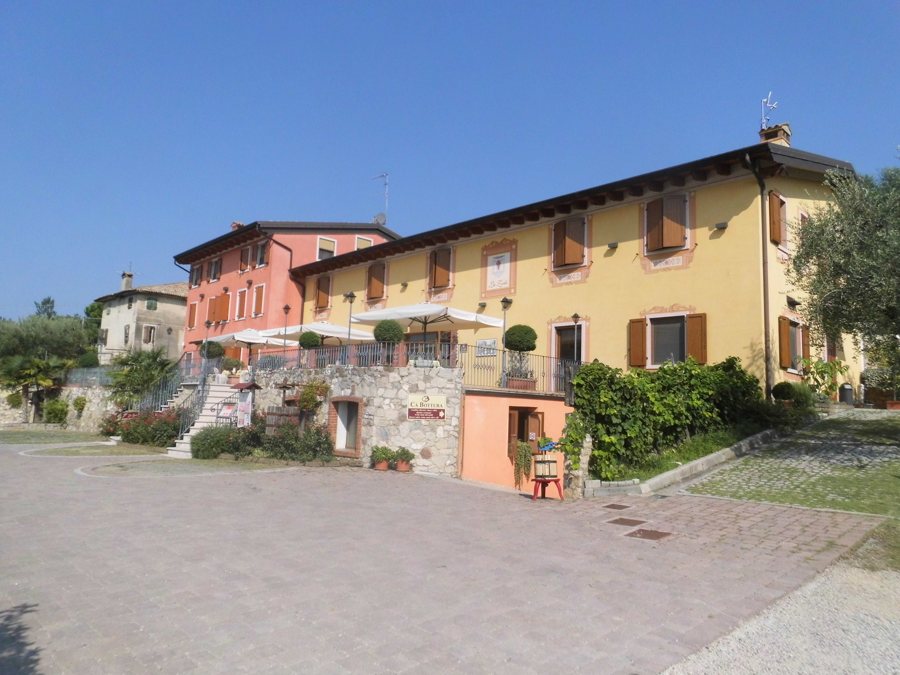 Außenansicht eines Weinguts in der Gegend von Bardolino.
Photo: Bernd Herman, neandertours.com
Außenansicht eines Weinguts in der Gegend von Bardolino.
Photo: Bernd Herman, neandertours.com
Its location explains much of Bardolino’s development. The lake forms the municipality’s western boundary, while the moraine hills rise to the east. This close combination of water and rising land shapes the views from the shore as well as the routes between the main town and its outlying villages. It also makes a difference when choosing a base: accommodation in the town centre puts the lake and its historic streets at the heart of your stay, while a stay in the surrounding countryside focuses more on the hilly landscape. Accommodation around Lake Garda is spread across very different lakeside and inland towns, so it is worth comparing their locations with Bardolino itself.
An old town centre between the shore and the hills
The history of settlement in the area reaches far back. The municipality points to traces of a pile-dwelling settlement in Cisano and numerous finds from Roman times. Bardolino’s medieval development was closely linked to the fortifications along the lake: according to the municipal account, an early castle was built towards the end of the ninth century. The Scaliger family expanded the complex; the layout of its towers, gates and streets preserved the basic features of the fortified town in later centuries. A map from 1439 shows an almost square ring of walls with an opening towards the lake.
The layout of the streets in the centre also tells of the town’s relationship with the water. The municipality describes Bardolino as a former fishing village whose rows of houses ran inland from the shore. Its lanes and squares are therefore more than just a backdrop for a stroll: they are part of a settlement pattern that connected access to the lake with life along the waterfront. You can better appreciate this connection by turning away from the water towards the older streets, rather than seeing the town centre only as a straight promenade.
Notable historic buildings include the churches of San Severo and San Zeno. The municipality’s historical account dates San Severo to 893 and describes the present building as having been constructed on the site of an older temple. The two churches represent different layers of the town’s history; their significance comes not only from their age, but also from their place within the historic settlement. Opening hours and access may change, so they are not among the permanent features that can be relied on when planning a visit.
Cisano and Calmasino are part of the municipality
Bardolino is more than the main town on the lake. Cisano is also on the shore and is connected with the area’s early settlement history; Calmasino is one of the villages in the hilly hinterland. Visitors staying for several days can therefore experience the municipality as a succession of contrasting landscapes: the shoreline, the town centre and the higher ground are close to one another, but they are distinct destinations. When staying in Cisano di Bardolino or Calmasino, the exact location should matter more than the fact that the place simply belongs to Bardolino.
The southern neighbour, Lazise, and the northern neighbour, Garda, help put Bardolino’s position on the eastern shore into perspective. Comparing it with Lazise brings a different town centre and a different stretch of waterfront into view; Garda lies farther north on the same side of the lake. The towns can be combined as individual stops, but their names do not refer to interchangeable stretches of beach. If you are considering staying in more than one place, it is worth considering distances, waterfront locations and the excursions you want to take together.
From a lakeside town to the Province of Verona
Over the centuries, Bardolino changed political allegiance several times. After the rule of the Scaliger and Visconti families, the town came under the Republic of Venice in 1405; this period ended in 1797. Austrian and Napoleonic rule brought further changes, before Bardolino became part of the Kingdom of Italy in 1866. Its history is part of the broader story of Lake Garda’s shores and the Province of Verona, not just the city of Venice. Those wishing to combine culture and scenery can therefore compare Bardolino with a stay in Verona: the history of a major city takes centre stage there, while Bardolino’s character is shaped by its lakeside location, the structure of its outlying villages and its small-town centre.
The landscape should also be viewed in its historical context. A municipal protection order issued in 1955 recognised the value of the lakeside strip and the neighbouring olive-covered hills; further orders followed in 1963 and 1975. These texts set out the historical reasons for protection and are not a current survey of every property. They do, however, make clear that the area’s appeal lies in more than the water: the shore, small coves, green spaces and hills behind them together form the distinctive landscape.
Bardolino is especially well suited to travellers who want to combine a stay on the eastern shore with walks through a town with a long history. Those planning a tour can compare it with other destinations on Lake Garda; those who would rather remain in the province and add larger cultural destinations can choose Verona for a different focus. The key is not to fold the whole lake region into a single place name: Bardolino includes the main town and its outlying villages, while Garda, Lazise and Verona each offer their own bases and travel choices.
