
Belluno: City life between the Piave and the Dolomites
Find accommodation
Belluno is well suited to travelers looking for a compact city with a distinctive historic center, while wanting the mountains to be more than just a backdrop. The old town sits above the Piave and can be explored on foot through a few connected districts; beyond the center, views open up over the Dolomites and a much broader landscape. Belluno makes a good base for anyone wishing to combine culture, city life, and nature. For a holiday focused primarily on high-alpine destinations, however, the city is better seen as a starting point than as a substitute for staying in the mountains themselves.
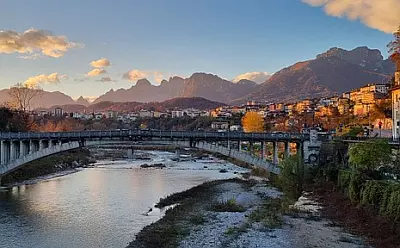 Belluno
Photo: Francesco Foti auf Pixabay
A town center between river and mountains
Belluno’s setting explains much of its character: the Piave runs along the valley floor, while the old town occupies higher ground. Walking between the riverside and the center, you pass from open landscapes to streets lined with buildings. This sets Belluno apart from many holiday resorts whose daily life revolves around a lakeshore or a single mountain station. Here, city squares, churches, and palazzi are just as much a part of a visit as the surrounding valleys.
Piazza Duomo is a good place to get your bearings. The cathedral of San Martino and several important civic and noble palaces, including Palazzo dei Rettori, stand around the square. From here, streets and lanes lead to other squares and into the older parts of town. Rather than ticking off individual buildings in isolation, take note of how the spaces unfold: grand squares, narrower passages, and views toward the river or mountains help make sense of the city’s scale. Belluno’s urban setting and historic surroundings are also put into context on the page about the Province of Belluno.
On the edge of the historic center, Borgo Piave tells a different story of the connection between town and landscape. This neighborhood was once a river port; timber from the mountains was carried downstream on rafts and traveled along the Piave as far as Venice. Its history shows that Belluno was never simply an isolated mountain town. The river, valley, and long-distance trade connected communities in the hinterland with the plains and the lagoon. On a walk around town, including routes beyond the central squares reveals this less monumental side of Belluno.
Art and everyday life, without long distances
The city center is especially convenient for a short stay when you want to combine different interests: architecture, a museum visit, a café stop, and a stroll beneath the arcades, all without having to travel between far-flung holiday destinations. Palazzo Fulcis houses the city museums, with collections ranging from archaeological finds to later art. It is a worthwhile complement to the facades and churches outdoors, but not a reason to spend the whole day inside. Visitors treating Belluno as a city break can easily combine culture with a pause in the center.
Piazza dei Martiri is another focal point of everyday life. Its cafés and shops give it a different feel from Piazza Duomo, which is more strongly defined by its churches and historic buildings. A walk between the two squares lets you take in not only the sights but also the changing character of the city’s spaces. For travelers short on time, a focused stroll through the center is enough; adding a museum visit makes for a half- or full-day cultural outing. There is no need to set a fixed timetable, since the pace and breaks depend on how thoroughly you explore the collections and streets.
Belluno as a base: what works well together
The city is particularly suitable when your itinerary includes several shorter excursions rather than a single mountain destination. The surrounding area has valleys, smaller towns, and alpine destinations, each requiring its own routes and daily plans. Belluno itself offers an urban counterpoint: in the evening, you return to a city setting rather than staying in a resort throughout your trip. However, if you plan to set out early every morning for a particular mountain route or mainly want to access ski slopes and high-altitude trailheads, it makes sense to stay closer to your destination. This helps avoid underestimating daily travel times and the limitations of the available connections.
Different town profiles can help you choose where to stay in the province: Alleghe offers a different landscape from the city, while Cortina d’Ampezzo is much more closely associated with high-alpine scenery. The page on the Dolomites in Veneto also gives an overview of the wider natural region. These destinations are not interchangeable day trips: distances, altitude, and the activities you have in mind determine whether Belluno makes sense as a fixed base or whether a second overnight stop will save time.
For an overnight stay in Belluno, there is a dedicated accommodation directory for Belluno. This is most useful when the city itself is the main focus of your trip. If you are planning nature excursions in several directions, keep in mind when choosing where to stay that the province is large and topographically varied. A centrally located address makes it easier to get around Belluno; it does not automatically bring remote valleys close by. Accommodation in individual mountain towns is therefore a separate choice and should not be confused with choosing a place to stay in the city.
Who Belluno is especially suited to
Belluno is a good choice for culture lovers who would rather experience a manageable city than a self-contained resort, and for travelers on a tour who want to discover more of Veneto than just its coast and lagoon. Even in changeable weather, the city center offers several ways to spend the day: squares and architecture outdoors, collections indoors, and then a return to the streets of the old town. Families and groups with different interests can divide their time between the city and surrounding area instead of organizing every activity around a single theme.
Belluno is less suitable as a one-size-fits-all base for every Dolomites holiday. If you want to stay right by a particular hiking area, lake, or winter sports resort, booking accommodation there will usually mean shorter journeys. Belluno’s appeal lies above all in the combination of urban history, the Piave Valley, and accessible mountain scenery. It is this mix that makes the city more than just a stopover, without confusing it with the province’s more specialized holiday destinations.
