
Ski holiday in Veneto: which area is right for you?
For a ski holiday in Veneto, the Dolomites in the north of the region are the main option. The first decision is not how many kilometres of slopes you want, but where to base yourself: Cortina d’Ampezzo, the Civetta area, Arabba–Marmolada and Falcade each offer a different geographical focus. If you want to stay in one place for several days, you’ll need a different plan than a group that deliberately wants to explore several ski areas. A regional ski pass extends the areas covered by your ticket, but it does not turn separate valleys into one continuous network of slopes.
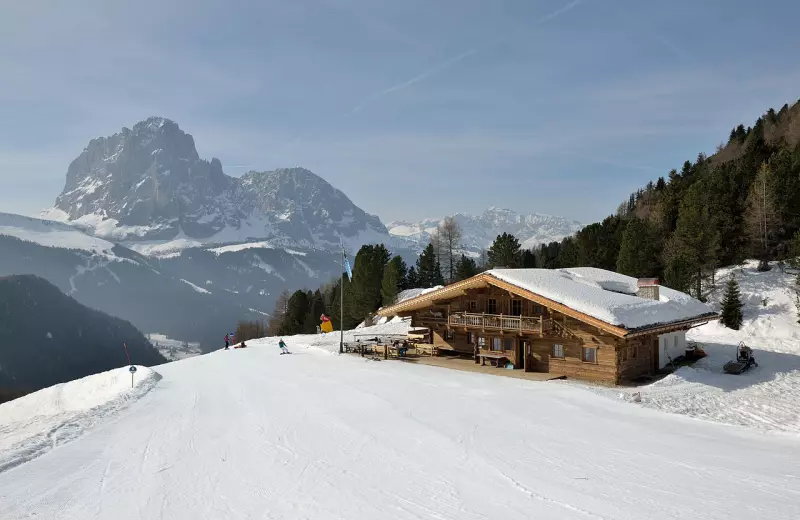 Skiurlaub in Venetien
Photo: Wolfgang Moroder / Wikipedia.de, CC BY-SA 3.0
Four bases for four kinds of winter trip
Cortina d’Ampezzo combines a well-known winter sports resort with a lively town. The valley basin is a distinct travel area in the Belluno Dolomites. Staying in Cortina d’Ampezzo is therefore especially suitable if spending the evening in town matters as much as skiing during the day. When choosing, consider whether you plan to visit restaurants and stroll around town after skiing, or would rather return to your accommodation as directly as possible. The name Cortina alone tells you nothing about how close a property is to the access point you want to use.
The Civetta ski area covers the slopes around Alleghe, Selva di Cadore and Val di Zoldo. It’s worth comparing the different locations within the area: which one suits your group’s daily routine? A family that wants to meet at the same place in the afternoon will have different priorities from a couple hoping to spend as much time as possible on the slopes. Choosing a valley also determines where your ski day starts and where you return in the evening.
Arabba–Marmolada is another distinct area. If this part of the Dolomites is your main destination, staying in Arabba can keep your trip focused on it geographically. Arabba shouldn’t be seen simply as a substitute for Cortina or Alleghe. If you plan to switch between these areas, your holiday changes from a stay with familiar routes into a trip involving additional transfers. For a short ski break, it’s often more enjoyable to choose one clear focus.
Falcade is part of the Alpe Lusia–San Pellegrino area, which extends beyond Veneto into Trentino. The older term Trevalli is used in connection with the Fassa, Fiemme and Biois valleys. On the Veneto side, Falcade is the main point of reference. Alpe Lusia and San Pellegrino–Falcade are separate ski sectors. This matters especially if you’re planning a short stay and don’t want to travel to a different starting point every day.
Set your ski days first, then choose your ski pass
A stay focused on one area and a trip through several ski areas call for different kinds of tickets. The Alpe Lusia–San Pellegrino area pass covers Alpe Lusia, Bellamonte, Passo San Pellegrino and Falcade. Dolomiti Superski covers a larger network. That wider coverage is only a practical advantage if the additional areas are actually part of your planned ski days. Your ticket should fit your itinerary, not force you to change it.
So keep two questions separate: where is the pass valid, and how do you get there? The first concerns access to the lifts; the second, the geographical connection between areas. Alpe Lusia and San Pellegrino are separated by a road transfer. A tour through several valleys is therefore logistically different from spending repeated runs in a compact ski area. Bear this distinction in mind to avoid a day plan where getting there and back takes time away from the snow.
A mixed group needs a shared rhythm
When abilities vary, the most challenging run someone wants to try is not automatically the right benchmark for the whole holiday. Beginners need time to learn, a consistent starting point and breaks. More experienced skiers may want to explore areas farther afield. A well-planned day allows for both, without expecting the slowest person to join a long tour. Agree on a meeting place for lunch or the return journey later in the day, and set a clear time frame for any separate activities.
Companions who don’t ski also influence the choice of location. If some guests plan to spend most of their time in town, the surroundings of the accommodation matter more than access to a particular run. For a trip focused on Civetta, for example, you could consider accommodation in Alleghe as a starting point, then choose a property whose location suits your group’s daily routine. Choosing a location doesn’t settle the question of amenities: a hotel and a holiday apartment support different routines for meals, breaks and evenings together.
Where you stay: the return journey matters as much as the start
The most important connection during a ski week is often the route you travel every day between your accommodation and the slopes. A property may be in the resort you want and still require a different start to the day than you expected. If you’re staying on the Falcade side of the San Pellegrino area, comparing accommodation in Falcade is a good place to start. After that, consider how the morning works with your equipment and whether getting back is practical for tired children or adults who have been skiing separately.
A holiday apartment offers flexible mealtimes and a shared living space, provided the property you choose has those features. In a hotel, the meals on offer can make evenings easier. Neither is a feature of the ski area as a whole. Include somewhere to dry clothes, space for equipment, and the route from your vehicle or public transport to the property in your day-to-day planning. Details like these can shape a ski week more than a long list of slopes you could theoretically reach.
Spend a week getting to know an area instead of changing valleys every day
For three or four days of skiing, an area with the same starting point each day is often enough. Use the first day to settle in and get to know your routine. After that, you can explore different parts of the area instead of planning a new journey each day. On a longer trip, you can add a day in another area more deliberately. It should offer a genuine change, such as a different landscape or a different kind of ski day, rather than simply making the list of places you’ve visited longer.
For example, a group chooses Civetta and stays in one of its three valleys. Two days together help establish familiar meeting points; afterwards, more experienced skiers can broaden their horizons while others stick to the routine they know. Another example is a stay in Falcade with a separate day at Alpe Lusia. Treat this change of area as a day plan in its own right, not as an incidental extension of a run. That way, the journey back to your accommodation remains part of the plan.
Keep a winter holiday and a touring trip distinct
Veneto stretches from the Dolomites to the Adriatic. A ski holiday in the Belluno Dolomites and a visit to Venice are therefore two separate parts of a trip. If you want to combine them, it usually works best to stay in different places and set aside clearly defined days for each. For an overview of the mountain towns, see the guide to the Province of Belluno. It distinguishes the different areas instead of treating every well-known town as an equally suitable base for the same ski week.
A successful ski holiday comes from three decisions that work together: choosing a geographical focus, planning a realistic routine for the whole group, and finding accommodation that supports that routine. Cortina, Civetta, Arabba and Falcade each offer a different option. If you first picture the kind of day you want, then choose your location, accommodation and pass, you’ll end up with a concrete plan. The widest geographical coverage isn’t automatically the best choice; what matters more is making your available ski days genuinely enjoyable holiday days.
