
Getting to Venice: from your arrival point to your accommodation
For accommodation in Venice’s historic city, Venezia Santa Lucia is the right rail arrival point. By car, the journey ends at Piazzale Roma or Tronchetto. From Marco Polo Airport, you can choose between road and water connections; from Treviso Airport, the transfer first travels overland. What matters in each case is the final leg to your address: arriving at the edge of the city and reaching a stop near your neighborhood involve different routes.
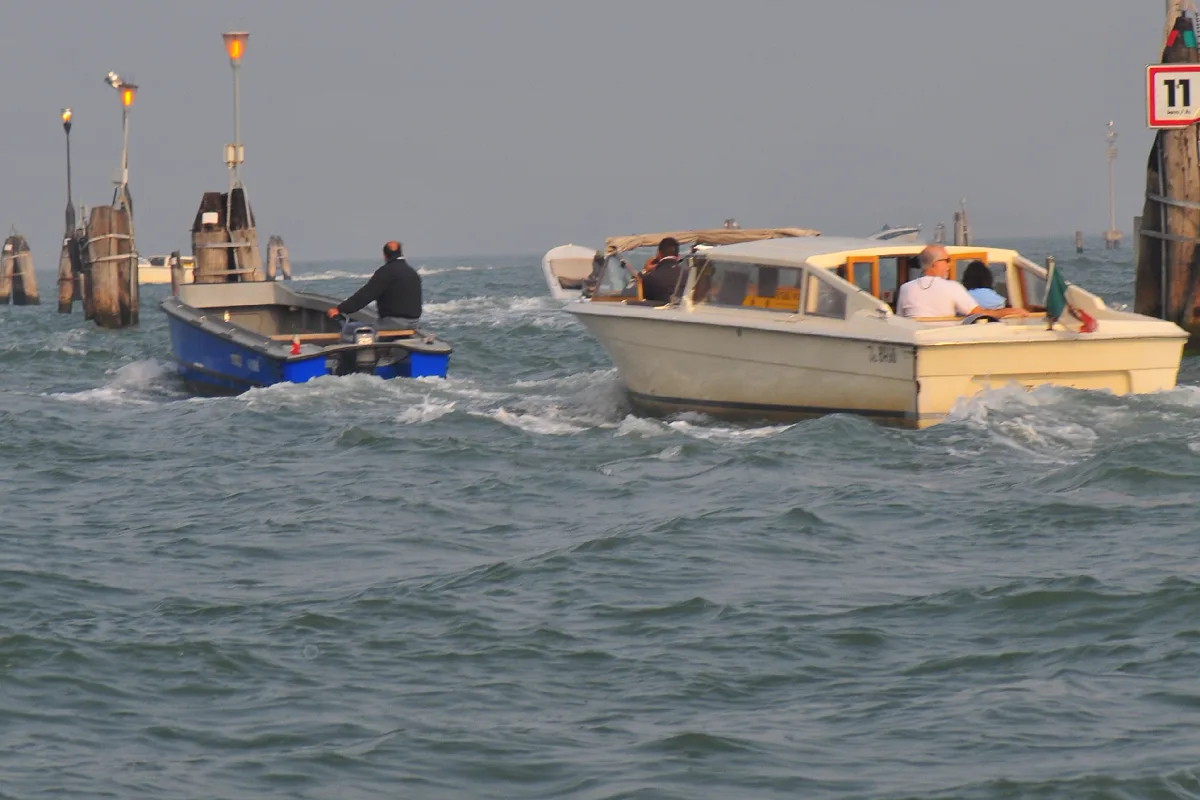 Motorboote fahren zwischen Fahrwasserpfählen über die Lagune von Venedig.
Photo: Alesia Belaya
Motorboote fahren zwischen Fahrwasserpfählen über die Lagune von Venedig.
Photo: Alesia Belaya
The journey can therefore be divided into two parts. The first ends at the railway station, airport or parking area. The second takes you with your luggage to your accommodation and in Venice may involve changing modes of transport again. Taking this second part into account avoids assuming that every connection bearing the destination name Venice takes you right to the door. The historic city, the mainland and the lagoon islands are different arrival areas.
Santa Lucia or Mestre: choose the station that suits your address
Venezia Santa Lucia is right in the historic city. The Grand Canal area begins just outside the station. From here, you continue on foot or by water bus. A rail arrival here can therefore mean a different final journey for accommodation in Cannaregio than for an address near San Marco. Both are in Venice, but they are not equally close to the station building.
Venezia Mestre is the station on the mainland. It is a suitable arrival point for accommodation on the mainland. For an overnight stay in the historic city, however, you still need to travel on to Venice, and only then begin the actual journey with your luggage. So a connection shown as going to Mestre is not the same as one going to Santa Lucia. When choosing accommodation in Venice, this distinction is more useful than a general distance from the city.
Arriving by car: parking and visiting the city are separate stages
Piazzale Roma is at the western entrance to the historic city and links road arrivals with the first walking routes. Tronchetto is an outlying parking island and another arrival area. Beyond these road terminals, you cannot continue your visit by car. An accommodation address in the historic city is therefore not a driving destination for the entire journey.
For a stay of several nights, the car is not a means of getting around the historic center day to day. The practical difference between the parking locations is mainly how you start the connection to your accommodation. A short distance on the map does not eliminate the need for that connection. For a day visit, the return to the same parking area is part of the plan; it starts when you leave your last destination in the city, not only once you reach the edge of the historic city.
Marco Polo by bus: arriving by road
Marco Polo Airport is on the mainland. ATVO operates airport bus services to Venice and Mestre. For the historic city, the road connection takes you to Piazzale Roma; from there, you continue on foot or by water bus. This option makes particular sense if your neighborhood is on the western side of the city. But a bus to Venice does not mean that accommodation in eastern Castello is already within reach.
Mestre as a bus destination is a different option, suited to an address on the mainland. If you are staying in the historic center, do not confuse this extra leg on the mainland with arriving at Piazzale Roma. Comparing neighborhoods and places to stay helps put your arrival point in context: Santa Croce and western Cannaregio involve different luggage routes from San Marco or eastern Castello.
Marco Polo by water: the destination stop matters
Alilaguna connects Marco Polo Airport by water with the historic city, Murano and the Lido. If your neighborhood is near a suitable stop, this can bring you into a different part of Venice than a bus ride to Piazzale Roma. The benefit depends on the destination stop and the walk from there to your address, not simply on the fact that the journey crosses the lagoon.
A water connection is not automatically faster, nor is it automatically a transfer to your door. Boarding, the ride, any intermediate stops and the final walk all form part of the journey. An address with a lovely canal view may not be right next to a served stop. For a stay on Murano, by contrast, a suitable water arrival can be a particular advantage, since the island is not reachable as a continuation of a walk through the historic city.
The airport journey and later vaporetto trips are different parts of the journey. To compare bus and water transfers, consider the entire route to your neighborhood in each case. An apparently direct route loses its advantage if a long walk with luggage follows after you get off; a ride followed by a short walk may work better in practice.
Treviso: first the overland connection, then the route through the city
Treviso Airport is outside the Venetian Lagoon and is not Marco Polo. ATVO operates airport bus services to Venice and Mestre. This means your arrival begins overland; accommodation in the historic city or on an island requires its own final leg. Flying to a destination listed as Venice does not erase the difference between the two airports.
When choosing a flight, therefore, compare the entire arrival journey to your neighborhood. The flight price alone does not reflect the effort involved. A later landing leaves less time for onward travel and checking in to your accommodation. If you do not have an extra day free during your stay, arrival is also not the right time to add a trip around the islands. Your first evening can simply be for settling in.
Treat island accommodation and cruise terminals separately
The Lido di Venezia is an island between the lagoon and the Adriatic. If you are staying there, the water journey remains part of your arrival, even if the first leg of your trip is by train or car. The same principle applies to other lagoon islands: travelling to the historic city and arriving on the island you have chosen are not the same stage of the journey.
For a cruise, the terminal assigned to your trip determines where you arrive. Marghera and the historic city are different areas; a railway station, airport or parking area does not tell you where to embark. The relationship between Venice and Marghera as a cruise port should therefore be considered separately from a regular hotel arrival. A city visit before or after the cruise requires its own travel arrangements and a solution for your luggage.
With luggage, the shortest straight-line route is not always the best
Canals and bridges change the final leg of your journey. A nearby building on the opposite side of a canal may require a detour, and steps make wheeled suitcases and strollers harder to manage. For people with limited mobility, the specific sequence of bridges matters more than the name of the neighborhood alone. No general description such as central or near the station guarantees a step-free route.
Arriving with little luggage and a manageable walk is different from bringing several suitcases for a family. In the latter case, accommodation near the right arrival point may be more useful than being close to a single famous landmark. Once you have dropped off your luggage, you can explore the city of Venice without it. The route to your accommodation and your first stroll do not have to be the same.
Plan your return journey from your accommodation
For your return trip, the journey starts at your accommodation, not at the railway station or airport. If you are leaving early, the first leg on foot or by water is especially important. An address that works well for sightseeing during your stay may mean an extra journey on departure day. You can weigh these two advantages against each other without declaring one type of arrival universally best.
The basic choices are clear: Santa Lucia for direct rail access to the historic city, Mestre for a stay on the mainland, Piazzale Roma and Tronchetto for road arrivals, and suitable stops for water transfers and island accommodation. From there, the final leg takes you to your address. Only when this geographical match is right do the outward journey, overnight stay and return trip come together as one coherent journey.
