
Venice’s districts: arrival, daily destinations, and places to stay
For a first overnight stay in Venice, Cannaregio and Santa Croce are especially appealing because of their proximity to arrival points; San Marco and San Polo for their central attractions; Dorsoduro for art and southern waterfront walks; and Castello for its extensive eastern area. The right choice depends on which routes you will make every day. Being close to the train station, a short walk from St Mark’s Square, and a location on the open waterfront are three different advantages; the same address rarely offers all three equally.
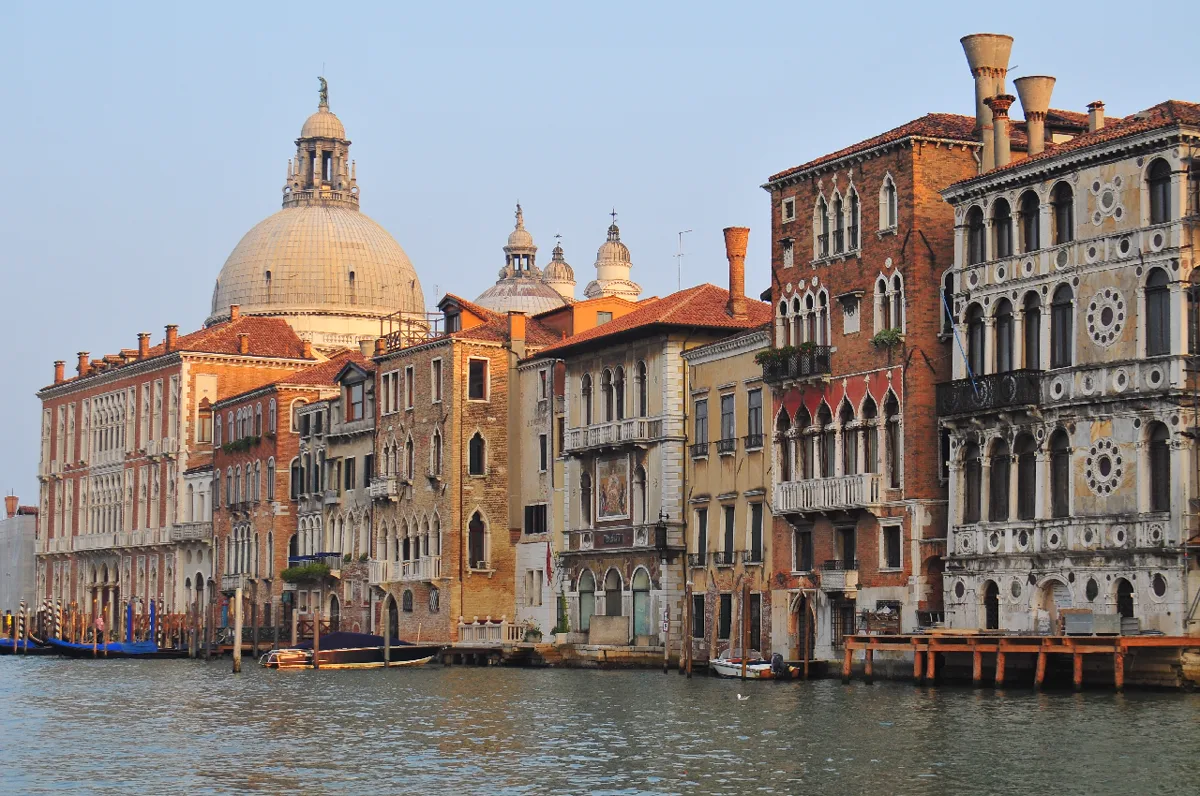 Historische Paläste und Boote am Canal Grande mit Santa Maria della Salute im Hintergrund.
Photo: Alesia Belaya
Historische Paläste und Boote am Canal Grande mit Santa Maria della Salute im Hintergrund.
Photo: Alesia Belaya
Venice’s historic city has six sestieri. A sestiere is not a uniform area to stay in: Cannaregio includes both the area around the train station and more distant northern neighborhoods, while Castello includes both central routes and the far eastern area. That is why the exact location within the district matters when booking. Even a room with a canal view may involve an extra walk, while an unassuming lane close to where you arrive can be especially convenient in day-to-day travel.
Two routes matter more than the prettiest spot on the map
The route with luggage on arrival and the return journey after a long day of sightseeing are the most important points of comparison. A location may be convenient for the first but less so for the second. If you are staying only briefly and leaving early, an easy arrival route is more beneficial. If you are spending several full days at the same art venues, you may want to prioritize being close to them and accept a longer transfer at the start.
Venezia Santa Lucia station is on the edge of the historic city, while Piazzale Roma is the arrival point for road transport. Tronchetto is another parking and arrival area. For getting to Venice, this distinction makes a considerable difference: accommodation near Santa Lucia is not automatically close to the bus arrival point, and an address by San Marco cannot be reached directly by car. Bridges and the final stretch after a waterbus ride are part of the actual journey with luggage.
Cannaregio: arrival by train or a northern residential district?
Cannaregio is an obvious choice if Santa Lucia station determines the beginning and end of your trip. Its western part shortens the journey from the train to your accommodation. However, the route toward Rialto is also a main thoroughfare; being near the station does not automatically mean a secluded location. For a short trip, though, practical proximity may matter more than particularly peaceful surroundings.
Further into the district, the historic Ghetto, side canals, and northern waterfront create a different setting. These locations suit a stay where an evening stroll through Cannaregio itself is part of the appeal. But they should not be confused with accommodation right by the station. Fondamente Nove is also a reference point for trips to the northern lagoon. Anyone planning several island visits will have different daily destinations from someone who will spend most of their time around San Marco.
Santa Croce: a short start after arriving by bus or car
Santa Croce is particularly close to Piazzale Roma along its western edge. This is a tangible advantage if you have suitcases or a stroller, or are leaving early. The location also works well if you mainly want a convenient starting point for exploring the city. However, walking to the monumental center is a separate leg of the journey; being close to the road arrival point is not the same as being close to St Mark’s Square.
At the same time, the district has its own squares and historic churches, including San Giacomo dall’Orio, and is more than just a transit area. Accommodation farther inside the district may feel more immersed in its surroundings, while an address right on the edge by the arrival point may feel more functional. So when choosing between Cannaregio and Santa Croce, it is less a question of each district’s general reputation than whether the trip begins by train or by road, and which starting point shortens the journey with your luggage.
San Polo: Rialto as your daily hub
San Polo suits travelers who value central walks on the western side of the Grand Canal. Rialto and its market area give the neighborhood a distinctive focal point. The Frari Church and Scuola Grande di San Rocco also make it an interesting base for art visits. If you spread these destinations across several days, you won’t have to travel to them each time from a distant neighborhood.
The central location makes itself felt in the daily rhythm: visitor routes converge around Rialto. Some side streets have a different feel from the area immediately around the bridge. And despite its proximity on the map, San Marco requires crossing the Grand Canal and walking through additional lanes. San Polo is therefore a good choice for a varied city itinerary, but it is not the same as staying right by St Mark’s Square.
San Marco: the monumental center right outside your door
San Marco is worth considering if St Mark’s Square, St Mark’s Basilica, and the Doge’s Palace are central to your visit. Staying nearby makes it easy to return after a visit and to take a short walk in the morning or evening. For travelers who mainly want to explore this area, that advantage may outweigh the longer journey from the train station or Piazzale Roma.
Even so, the district does not guarantee short journeys in every direction. Destinations in Cannaregio, Dorsoduro, or the northern lagoon are elsewhere. If you spend several days merely passing through San Marco, you may not make much use of its proximity. The choice between San Marco and San Polo can therefore be made in concrete terms: proximity to the monumental square on one hand, and Rialto and western art venues on the other. Both are central bases, but they are different starting points.
Dorsoduro: between art collections and the southern waterfront
Dorsoduro is especially appealing if the Accademia, the Peggy Guggenheim Collection, and Santa Maria della Salute are on your itinerary. The Zattere add open waterfront views to these art venues. Staying in the district makes it easier to combine sightseeing with a break in the same area, rather than first having to return to another part of Venice. Being close to the waterfront and being close to a collection are separate location advantages.
The Giudecca opposite belongs to the sestiere, but it is not connected by a pedestrian bridge. Staying there means taking water transport to reach the rest of the historic city. This creates a different daily routine from staying near the Accademia or the Zattere. For getting around by vaporetto, the stop becomes a regular part of the trip, especially when returning in the evening.
Castello: a central west and a distinct east
Castello offers the widest range of locations to choose from. Its western area is near San Marco, while farther east the Arsenale and Giardini become important reference points. For a visit to the Biennale, staying near the exhibition areas may be more useful than being close to the train station. For a short, classic city break, the western part may be a better fit.
An address far to the east suits travelers who deliberately want to include this part of the city. It should not be chosen simply as a supposedly quiet alternative if your daily destinations are on the other side of the city. Even within Castello, through-routes, waterfront areas, and side streets differ. A long evening walk can be pleasant if it is part of the experience; after a tiring day, the same walk may feel like an extra burden.
The Lido, Mestre, and the islands are different bases
The Lido di Venezia is not one of the six sestieri and offers a distinct focus, with its proximity to the beach and its location between the lagoon and the Adriatic. It can be a good fit for a stay that combines city and beach days. However, every trip to the historic city involves a boat ride. The Lido is therefore not simply an outer location in the old town, but a deliberately different place to stay during your trip.
Mestre is on the mainland. Road and rail connections change how you arrive and get around each day; every visit to the historic city starts with a journey. A mainland address can make sense on a regional tour, but an evening stroll through Venice followed by a quick return to your accommodation is less straightforward. Those who would rather stay on a lagoon island are choosing their accommodation for a distinct island experience. For Murano, Burano, and Torcello, craftsmanship and historic buildings are more meaningful points of distinction than any supposed proximity to all the city’s attractions.
Choose a location that suits the route you will repeat
When comparing places to stay in Venice, you can break down the district name into three practical questions: Where does your journey with luggage begin, which area will you visit every day, and how will you get back in the evening? A central address is especially useful if it brings these routes together. An outlying location makes sense when it offers a distinct advantage in terms of arrival, waterfront surroundings, or a particular cultural venue.
For families and people with limited mobility, the sequence of bridges also matters; none of the six district names guarantees a step-free route. A compact daily radius may be more advantageous than a midpoint between many widely scattered destinations. The walking tours of Venice give the districts a concrete focus for sightseeing. Finding the right place to stay means matching location to how you will actually use it, without declaring any one district the best overall.
