
Vaporetto in Venice: Combining Boat Rides, Walking, and Tickets
The vaporetto is Venice’s public water bus. Its usefulness depends not only on the route across the water, but also on the way to the departure stop and the final walk after you get off. For a short trip between nearby destinations in the city, walking may make more sense. For a lagoon island, by contrast, the boat ride is a separate, necessary leg of the journey. The right connection therefore depends on the actual destination stop and direction of travel, not just a route number.
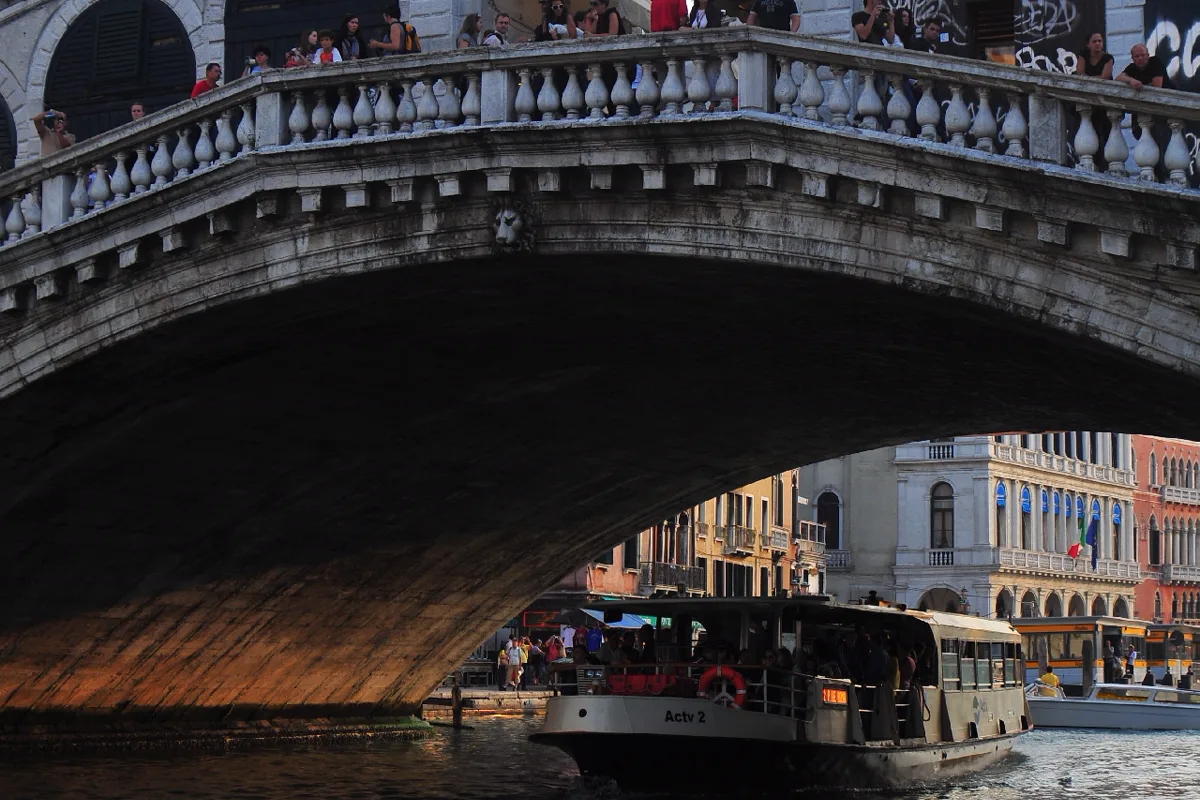 Ein Vaporetto fährt unter der Rialtobrücke auf dem Canal Grande in Venedig.
Photo: Alesia Belaya
Ein Vaporetto fährt unter der Rialtobrücke auf dem Canal Grande in Venedig.
Photo: Alesia Belaya
Vaporetti are part of the public transit system, not private water taxis or gondola rides. They serve stops rather than individual street addresses. So even if your accommodation is right on a canal, that does not mean there is a suitable public stop outside the door. This distinction matters especially when you have luggage: a longer boat ride can still mean a shorter final walk, while a seemingly nearby stop may require crossing extra bridges.
Consider the entire journey first, then choose the boat
A practical comparison starts from where you are. If a short walk connects both destinations, a boat ride must justify the additional walk to the stop, the wait, and the walk after getting off. But if the destinations are far apart or you are going to an island, the boat takes care of a much larger part of the journey. There is no blanket rule for the situations in between that the vaporetto is always faster or always unnecessary.
Staying near a suitable stop makes regular water journeys easier. For stays in Venice, the combination of accommodation, daily destinations, and stops is more informative than a canal view. Someone visiting an exhibition in the morning and staying in their own neighborhood in the evening needs a different travel plan from someone commuting daily from the Lido to the historic city.
At the stop, the destination and direction must match
The route shown on a sign is only one part of finding your way. The direction and the stop served are also part of the journey. At a larger stop area, different boarding points may serve different connections. So the name of a well-known destination is not enough to ensure that every boat you see there is the right one. The departure point and destination of the service must describe the same route.
Canals make which side of the water you’re on a practical consideration. A stop on the opposite side cannot always be reached in a few steps; the walk may take you to the next bridge. The same applies to the destination stop: being close to a museum or a home is only useful if the onward route works. Families with strollers and travelers with wheeled suitcases should try to minimize the number of such changes.
The Grand Canal is both a transport route and a city view
A ride along the Grand Canal offers a different view of the city from a walk through its alleys and across its bridges. From the water, you can take in the facades and waterfront in one continuous sweep. The ride can therefore be a destination in its own right. In that case, it makes sense to set aside time for it rather than treating it solely as the fastest possible way to get between two sights.
For a timed appointment, however, the entire journey remains what matters. A scenic view does not shorten the wait or the walk after the ride. If you need to get to a reserved visit or catch a train after the boat, include those parts in your plans. The water route can complement a walk; it does not have to replace every journey through the alleys. Many of the impressions of a single neighborhood are best gathered on foot.
Time passes start with the first validation
The basic options include a 75-minute single ticket and time passes for 24, 48, or 72 hours, as well as seven days. A time pass allows travel during its validity period, which begins with the first validation. A 24-hour pass is therefore not simply a pass for a particular calendar date. The first use and all subsequent journeys must fit within that time window.
The first consideration when choosing is how many water journeys you plan to take. A day spent mostly walking around the city with just one boat ride is different from a trip involving several journeys to the islands and back. A time pass can make repeated use easier; its name alone does not prove that it saves money for every itinerary. If you do not actually need the rides, a longer validity period is no benefit in itself.
A specific example makes the timing clear: if a 24-hour pass is first validated in the afternoon, it remains valid until the same time the following day. A later return trip will then fall outside that window. If you plan your first use for a journey you need to take, you can make the pass fit your stay. Having a ticket and traveling within its validity period are two conditions that go together.
Validate again when transferring
Validation is part of using the ticket; it must be done again when changing modes of transport. This also applies while a time pass is still valid. Confirmation at the reader therefore matters not only on the first use. Keep your ticket accessible throughout the journey rather than burying it deep in your luggage after the first ride.
For a group, a little coordination before boarding helps: everyone keeps their own tickets handy, luggage stays manageable, and you agree on a meeting point at the destination. With young children, a straightforward day’s route is often more useful than several extra transfers. The boat ride and getting off are part of the outing, not merely an interruption between the main sights.
Airport journeys are not simply your first vaporetto ride
The standard single tickets and time passes mentioned here do not cover connections to Marco Polo Airport. A city transit pass should therefore not be treated as a complete airport connection. Arriving at the airport, traveling onward, and making later trips around the city are separate legs. A package name or the general label “water transfer” does not change that distinction.
Alilaguna airport services and ACTV city transit serve different purposes. When choosing how to get to your destination, a road transfer and a water transfer are both options. Getting to Venice via Marco Polo, Treviso, and the railway stations therefore starts with your actual arrival point. Only then can you decide whether you need a vaporetto ride to your accommodation or during your stay.
For island visits, plan the return journey as part of the outing
Murano, Burano, and Torcello are not simply more stops on a walk around the historic center. The outward journey, any transfers, and the return trip are all part of visiting each island. A day that includes a craft museum and a walk around the island therefore involves more than the time spent traveling between two stops. Listing several island names in your itinerary does not in itself make for a well-balanced outing.
The choice between a glass-focused visit and a day centered on lace or early lagoon churches is a matter of interests first. Comparing Murano, Burano, and Torcello as day-trip destinations helps you choose a focus; then you can work out the right water route. If you are staying on the Lido di Venezia, by contrast, the boat ride is a regular part of getting around the city. These two kinds of use call for different numbers of journeys.
With luggage or limited mobility, consider the entire connection
A water bus can replace long stretches of walking, but it cannot avoid every bridge between a stop and your accommodation. With suitcases, a short final walk is often more valuable than getting off at a particularly central stop. The locations of Venice’s neighborhoods for your stay can therefore also be compared by the connections you need regularly.
For people with limited mobility, consider the walking distance, the sequence of steps, and the transfer at the stop together. Taking a boat does not mean that the entire journey is free of steps. A cruise also involves a separate transfer to the port: a vaporetto ride within Venice does not replace the check-in process at the Venice and Marghera cruise terminal. A well-chosen water route ends where the final connection also suits your actual destination.
