
Venice Carnival: Understanding the Masks and Planning Your Visit
A visit to Venice during Carnival can be a stroll among masks and costumes or a trip centered on a particular celebration. These two aims call for different day plans. If you mainly want to observe and take photographs, you’ll need flexible routes through the city and time for chance encounters. If attending an event is your main goal, plan your arrival, clothing, and return journey around it. The atmosphere in the streets and attending a single celebration are not the same experience.
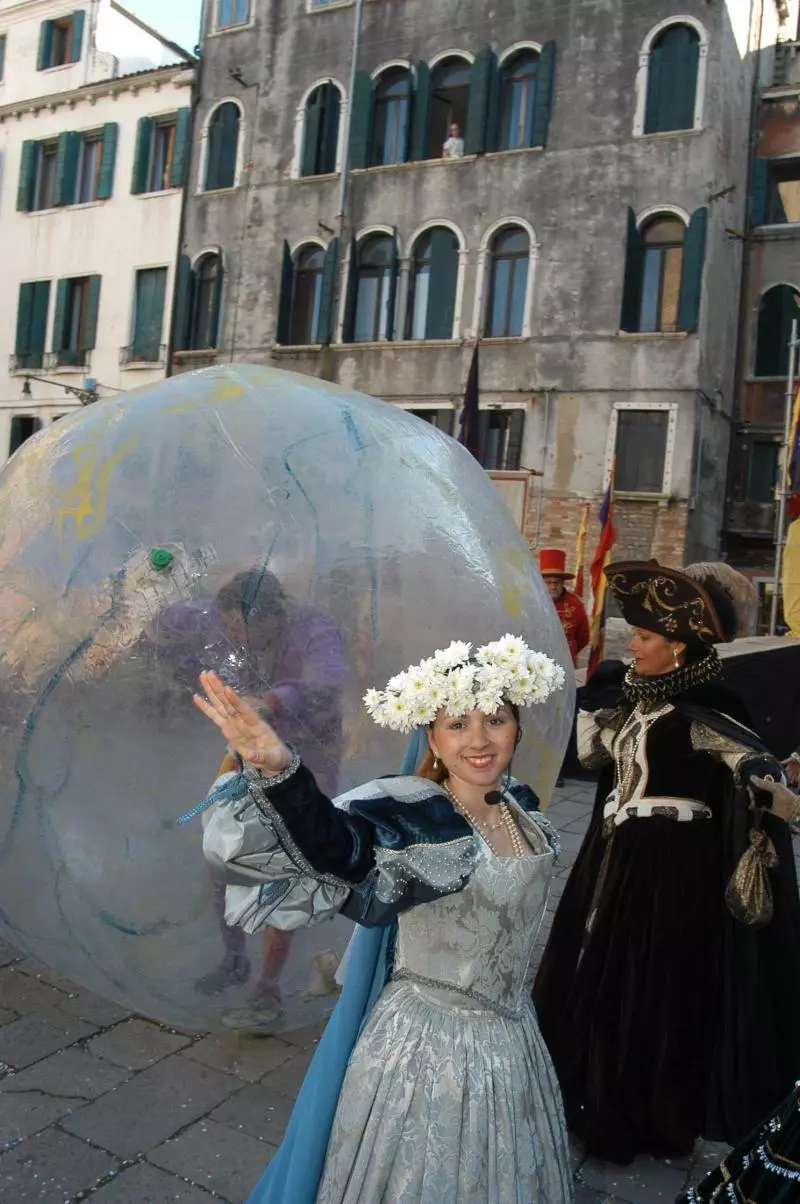 Karneval in Venedig
Photo: M. Lenk
Masks have a history of their own in Venice. They are not just elaborate decorations; they also represent anonymity, role-playing, and the temporary transformation of social conventions. Carnival was first recorded in 1094 and revived in 1979. Its present-day form brings historical motifs together with a renewed city festival. It would be misleading to imagine it as an uninterrupted event that has remained unchanged for centuries.
Bauta, Moretta, and Gnaga: three distinct ideas behind Venetian dress-up
The Bauta is a simple mask, often worn with a tabarro, a large black cloak. Together, they concealed the face and body and served to preserve anonymity. Its appeal, then, lies in more than decorative details. It embodies the possibility of moving through social life without being immediately recognized as a particular person.
The Moretta follows a different principle. This oval black velvet mask was historically worn by women and held in place by a small button between the teeth. It had no straps; the way it was worn prevented the wearer from speaking. Anonymity here came not only from concealing the face, but also from silence. This sets it apart from a mask whose appeal is simply its elaborate decoration.
The Gnaga combined a cat-shaped mask with a satirical costume in which men took on women’s roles. The role reversal was part of a playful challenge to social expectations. These three examples show just how differently Venetian dress-up can be conceived: appearing incognito, remaining silent, or portraying a different social role. Knowing these distinctions helps you see more in the masks than a collection of colorful accessories.
Observe and photograph without chasing every shot
A Carnival stroll is more rewarding when it follows a connected stretch of the city. A square, the adjoining lanes, and a walk along the waterfront make for a visit in which architecture and costumes can be enjoyed together. The monumental area around San Marco is a good place to get a first impression. Other neighborhoods offer different routes, so not every encounter has to take place against the same familiar backdrop.
When taking photographs, friendly communication and keeping pathways clear matter more than getting the shot as quickly as possible. A bridge is also a thoroughfare, and a doorway is not a photo studio. Large groups are better off gathering in a square than in the middle of a narrow lane. The city walks through Venice offer a range of areas to focus on, which can also be planned as a continuous route during Carnival.
An elaborate mask is no proof that a particular appearance is part of an official public program. People in costume may simply be visitors, too. If your main aim is to experience the city, you can take these encounters as spontaneous impressions without assuming every scene is a performance. Take in the fabrics, shapes, and gestures, and make time for breaks rather than turning the whole day into a photo chase.
Wearing your own mask: choose a costume you can get around in
Wearing your own costume changes the practical side of the trip. You’ll be moving over bridges, through narrow lanes, and perhaps onto a boat. A long train or bulky headpiece is one thing for getting around and quite another for a single appearance indoors. Comfortable shoes and a costume that does not unnecessarily restrict your vision or movement will make a longer day out in the city easier.
Your accommodation also takes on a different role: it is a place to get changed, store your belongings, and take a break between outings. When choosing accommodation in Venice, being close to your planned daily route may matter more than being near a single famous landmark. If you return in costume several times, you’ll be making the same journey repeatedly. This should carry more weight when choosing a location than how appealing it looks at first glance on a map.
A celebration is a travel occasion in its own right
Venetian Carnival brings masks together with theater and celebrations; palaces, too, are part of the festival tradition. A particular celebration, however, is a separate event to attend. An open-ended stroll around the city does not automatically take you inside. A masked walk is an experience in its own right and does not require attending a private palace party. Public life in the city and individual celebrations are different ways of experiencing the same occasion.
If you have an evening event as a fixed goal, keep the day beforehand deliberately lighter. Arrival, getting changed, and a short walk are easier to combine than a packed sightseeing schedule immediately before the evening. If you simply want to observe the masks, you do not need an evening event at all. The key difference is how you want to experience your visit—not which option is supposedly the only “real” Carnival.
Choose your accommodation location and return route together
Staying in the historic city makes it possible to walk back to your accommodation, but distances vary considerably even there. The six districts as places to stay can therefore be compared according to your planned daytime and evening destinations. Being near the railway station may be useful for a short stay, while several journeys to destinations in the eastern part of the city may call for a different balance.
Staying in Mestre means using the mainland as your base. For a Carnival visit, you’ll need to travel into the historic city and make the return journey after the festivities. This can work well for a trip that includes other mainland destinations, but it is not the same day-to-day experience as a short walk back to your accommodation. Especially after a long evening, this change of location should not be treated as an afterthought.
Your arrival by train or via the airports and later journeys by vaporetto are separate parts of the trip. Arriving with a costume and luggage is different from taking an ordinary stroll around the city. That’s why it often makes more sense to start exploring after dropping off your bags than to try to join in all the festivities immediately from your arrival point.
How much should Carnival shape your trip?
For a day trip, one area to focus on, with time to observe, take photographs, and pause for a break, is enough. With several nights, you can separate a Carnival day, an evening out, and an ordinary city stroll. If you’re traveling with children or a group with varied interests, a short shared main activity is often more practical than a plan with multiple meeting points scattered across the city.
A fixed duration of twelve days is not a reliable description of Carnival; each edition has its own calendar. But the main reasons for choosing this kind of trip remain clear: learning about the mask tradition, experiencing the city during the festivities, or taking part in costume yourself. Making one of these the focus gives your visit direction without reducing the rest of the city to a single backdrop.
