
UNESCO World Heritage in Veneto
UNESCO World Heritage in Veneto is not a single destination, but a group of very different places and landscapes. These include historic urban areas, works of art, a botanical garden, and natural or cultural landscapes. Some sites lie entirely within the region, while others form part of larger properties spanning several regions or countries. So the first question to consider when planning your trip is geographical: would you like to combine individual sights in a city, or are you drawn to a broader landscape?
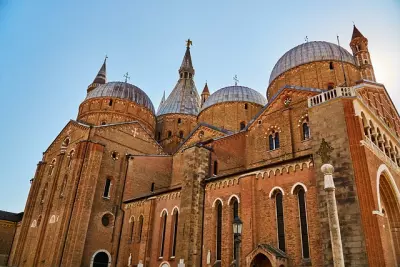 UNESCO Welterbe: Basilika des Heiligen Antonius (Padua)
Photo: NakNakNak auf Pixabay
UNESCO Welterbe: Basilika des Heiligen Antonius (Padua)
Photo: NakNakNak auf Pixabay
Venice and its Lagoon as a single World Heritage site
For Venice, the World Heritage site is “Venice and its Lagoon.” The name draws attention beyond the historic city to the relationship between the settlement and its watery landscape. A day spent wandering the streets, then, is not the same kind of trip as an excursion to other parts of the Venice Lagoon. Those interested in architecture and urban history will focus on different things from those who want to understand the lagoon landscape. The two can be combined on a longer trip; for a short stay, it helps to plan the historic center and the wider lagoon as separate day trips.
The World Heritage name describes a protected ensemble, not necessarily every individual sight or island. Nor is the designation a substitute for deciding what you want to see while you’re there. For a day in the city, squares, churches, and palaces can provide a guiding theme; for a day in the landscape, the waterways and the distinctive transitions between land and lagoon take center stage. This helps explain why Venice cannot be reduced to its famous façades alone, nor equated with the entire lagoon.
Padua: two distinct World Heritage connections
Padua is represented by two separate World Heritage sites. The Botanical Garden is one of the recognized properties, while the 14th-century fresco cycles are listed under the name “Padua Urbs Picta.” This distinction is useful when planning a visit: these are not parts of a single complex that can be fully explored on one tour, but different places, each with its own history and character. If art history is your main interest, you can spend more time with the frescoes; if you’re interested in the history of science and gardens, you’ll find a different point of focus.
The number of individual stops and their visiting conditions are not inherent features of the UNESCO designation itself. For a trip, this mainly means that it’s best not to plan your day around a list of names alone. Instead, choose a thematic itinerary that suits your pace, and leave time for getting around the city. You can visit Padua as a destination in its own right or combine it with other places in the surrounding area, provided you allow enough time.
Verona and Vicenza: two different urban histories
The historic center of Verona and the city of Vicenza represent different urban traditions. Verona brings together Roman, medieval, and later history in a city center that has developed over time. Vicenza’s listing, by contrast, is associated with Palladian buildings and villas in the Veneto. Including both cities in a round trip therefore doesn’t simply mean having the same experience twice: the architectural themes and the sense of place are different. Choose according to what you’d like to explore in greater depth, rather than treating both places as more stops on a long checklist.
Nor should the villas be equated with a single building in central Vicenza. Their regional connection makes clear that this architecture extends beyond the city into the surrounding countryside. Visiting them may require a separate trip or an additional part of your stay. For a short trip to Veneto, it often makes more sense to explore one city thoroughly and save the other theme for a future itinerary than to cram far-flung places into a single day.
Landscape properties and shared listings
The World Heritage sites associated with Veneto also include the Dolomites. This mountain range is an extensive landscape, not a single viewpoint. For travelers, that means the area you choose will determine how much time you need for getting around and changing locations. A mountain stay follows a different rhythm from a city trip between Venice, Padua, and Verona. Fitting a mountain landscape into a short city day would usually make for a very different trip from a planned multi-day tour in the mountains.
Other listings extend beyond Veneto’s borders. The Dolomites include parts of several regions; the Prehistoric Pile Dwellings around the Alps and the Venetian defensive works of the 16th and 17th centuries are also shared properties. Peschiera del Garda is part of the Venetian component of the fortification network. A visit to Peschiera on Lake Garda can therefore show you one regional part of a larger ensemble, even though the entire World Heritage site is not located there. These shared listings are best understood as geographical connections, not as a promise that you can see an entire property in one place.
The Prosecco Hills of Conegliano and Valdobbiadene are also among Veneto’s World Heritage sites. Their name refers to a landscape between towns, not simply a city visit. If this is your focus, allow enough time to explore the countryside and travel between the different destinations. Its character is distinct from both the lagoon and the high mountains. Nearby Treviso can serve as a possible urban base, but visiting it is a separate travel decision.
Using the UNESCO list as a starting point for your own itinerary
The regional overview from the Italian National Commission for UNESCO lists nine World Heritage sites associated with Veneto. This figure also includes properties that extend beyond the region. It does not mean that nine compact attractions lie close together or can be visited on a set circular route. For choosing where to go, it’s more useful to group the sites by type: historic cities, individual places of art and learning, rural cultural landscapes, and larger natural and historical areas.
If you have several days, it’s easier to combine destinations within one area than to make a cross-region detour. A city-focused trip could center on Venice, Padua, or Vicenza; the variety of Veneto’s landscapes becomes especially apparent on longer trips; other routes lead to the foothills, Lake Garda, or the hills around Conegliano and Valdobbiadene. Choose your base according to the balance of culture and landscape you’re looking for. Staying in a city makes it easier to reach urban sights, while a rural base opens up different options. This turns the World Heritage list into a selection suited to your interests and the length of your trip, rather than a checklist you have to complete in full.
It’s best to start with a simple question: would you like your trip to be shaped by a city, an artistic period, or a landscape? You can add a second focus if time and geography allow. For example, if you’re staying around the Euganean Hills, you could explore other places in the southern Padua area; a trip to the hills south of Padua is a different kind of outing from a drive to the Dolomites. The Venetian Lagoon, Padua’s urban art, and the northern mountain landscapes are not interchangeable backdrops. It’s precisely these differences that make Veneto such a varied cultural and travel region.
