
Regata Storica: Distinguishing the Historic Parade from the Rowing Races
The Regata Storica brings together a historic boat parade and competitive rowing races on the Grand Canal. So visitors who mainly want to see costumes and decorated boats have a different focus from those who want to follow the races. Both are part of the event, but they meet different expectations. The regatta is not simply a gondola race with a decorative opening; it is a combination of Venetian historical memory and living rowing sport.
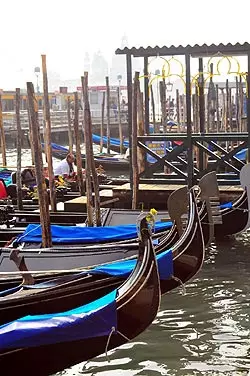 Gondeln in Venedig. Zur Regata Storica gehört ein Ruderwettbewerb auf dem Canale Grande
Photo: Alesia Belaya
It is worth understanding this distinction before planning the rest of your time in the city. A sporting focus calls for close attention to the course of the races. An interest in the parade, by contrast, draws the eye to the types of boats, historical figures and their presentation. If you treat the event as just another name on a list of sightseeing stops, you may easily miss the very part you came to see.
The boat parade commemorates Caterina Cornaro
The historic parade refers to the reception of Caterina Cornaro in 1489. She was married to the King of Cyprus and gave up the throne in favor of Venice. This memory provides a setting for the costumed figures and decorated traditional boats. The date 1489 therefore marks the historical reference behind the spectacle, not the beginning of Venetian regatta sport as a whole.
Early records of the regatta date back to the 13th century. The connection between the city’s history and rowing sport therefore extends further back than the individual episode involving Caterina Cornaro. For visitors, this explains why historical pageantry and competition take place side by side. The parade presents an image of the former republic; the races focus on the abilities of today’s rowers.
You can watch the parade closely for its visual impact: How do the boats differ? Which figures bring the scene to life? How does a decorated vessel stand out against the palace façades? This is a different way of engaging with history than a museum visit. Here, historical motifs are set in motion. Knowing a little about the event’s historical context makes the parade easier to understand, even if you cannot identify every person depicted.
Not every racing boat is a gondola
The sporting side belongs to voga alla veneta, the Venetian rowing tradition. Traditional racing boats include the pupparin, masc areta, caorlina and gondolino. These different names alone show why calling it a gondola race is too simplistic. Different types of boats and crews are part of the culture of competition, not merely variations on the same tourist gondola ride.
A gondolino should be understood as a distinct type of racing boat. The parade’s decorative boats, in turn, serve a different purpose from the vessels used in competition. Once you recognize this distinction, you can shift your attention after the parade: away from the decoration and costumes, and toward movement, teamwork and the course of the race. This makes the sporting events a separate experience in their own right, rather than just an add-on to the parade.
For children or people with no prior knowledge, one simple question may be enough: Is the boat part of the historical pageant, or is it racing? From there, you can follow differences in the crews and the way the boats move. You do not need to know all the boat names. This comparison often gives a better sense of the event than expecting to see only the familiar black gondolas from the cityscape.
The Grand Canal is the event venue, not a continuous viewing promenade
The Grand Canal winds through the historic city, but its banks are not lined everywhere by a continuous footpath. Lanes may end at the water, crossing from one side may require a bridge, and nearby points on a map may have different access routes. So you cannot plan a visit simply by following the canal on a map. This remains true even when the event itself moves along the water.
For a day like this, finding your way around Venice is helpful: a city walk, a waterside view and the route back to your accommodation are separate parts of the day. For a group, an agreed meeting point in a square is more practical than a vague plan to meet somewhere along the Grand Canal. Bridges and narrow access routes are thoroughfares, not suitable places to gather for an extended period.
Limit the number of stops before and after the regatta
An event day can include fewer sightseeing stops than an ordinary day in the city. One continuous walk and a break fit better before or after the event than several major indoor visits. Adding a lagoon island means taking a separate boat trip; it is not a necessary finale to a day that already centers on the Grand Canal.
If the parade is your main draw, you can pair it with a part of the city where architecture and views over the water take center stage. If sport is your priority, leave more time for the races and make the rest of your walking tour secondary. Both approaches make sense. By contrast, half a museum visit, half a parade and an interrupted race rarely command the same attention as a clearly chosen focus.
Where to stay: choose for your own routes, not the event’s name
When choosing accommodation in Venice, what matters is the actual connection between your base and the parts of the city you plan to visit. A canal-side address alone says little about the route to a public access point on the water. A room with a view and being part of the city’s activity are also two different things you might want. After a long day at the event, the journey back should suit your group’s mobility and pace.
The city districts as places to stay each offer a different emphasis: convenient arrival, a monumental historic center or a longer stay in the eastern part of the city. Choose a suitable location based on the routes you will make repeatedly, not on a single rough distance figure. If you are staying for several days, your accommodation can also work well for other destinations around the city without being right beside the regatta route.
Staying on the Lido di Venezia makes an island your base. Returning across the water then becomes part of the day. For these journeys, vaporetto services are public transport, not automatically spectator boats for the regatta. A regular city ride should not be confused with a purpose-chosen experience of the event from the water.
Keep your arrival day separate from the event day
If you are traveling from farther away, spending an extra night before the event is one way to separate your luggage and arrival from your visit. After arriving by train or at the airport, you can first check in and leave your bags. Then you can head to the regatta without carrying the burden of your whole journey. A tight day trip with a fixed train connection, on the other hand, leaves less flexibility for a longer focus on the sport.
Within the events in Veneto, the Regata Storica has a distinctive character: historical memory aboard traditional boats and competition on Venice’s central waterway. Art events or an evening performance create a different rhythm for a visit. If you are traveling for the regatta, you can give it a day of its own and explore other sides of the city on the remaining days.
The key decision is simple: Should the parade be the main focus, the rowing sport, or both with enough time for each? Let that choice shape the length of your day and your routes. With a clear focus, a general wish to experience a Venetian event becomes a visit where the parade’s history and the competitors’ skill on the water each have their own place.
